
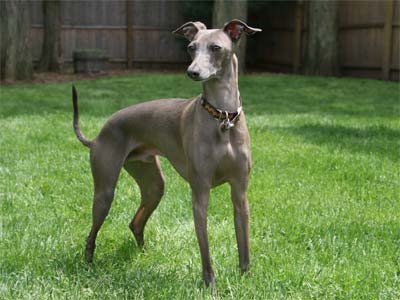
The affectionate Italian Greyhound is so playful that keeping them in pairs can provide a good outlet for all that energy!
The Italian Greyhound, also called the Miniature Greyhound, looks like a miniature version of the standard Greyhound. This miniature Italian Greyhound was developed by the Romans and highly favored by the nobility of that period. It is a toy sighthound breed, tall for a toy breed but within the weight standards. LIke all hound breeds it is a natural hunter and companion.
Italian Greyhounds are very gentle and affectionate, but they also have lots of energy and love to play. They will get along with everybody in the household, but can be territorial when strange dogs are around. These small dogs make good indoor pets as long as they get a daily walk to expend their energy. They are very intelligent and can be trained as watchdogs.
When selecting an Italian Greyhound, check bloodlines for eye problems, epilepsy, autoimmune disorders, von Willebrand’s disease, and thyroid problems. This breed is also somewhat prone to hip and joint problems.
- Kingdom: Animalia
- Phylum: Chordata
- Class: Mammalia
- Order: Carnivora
- Family: Canidae
- Genus: Canis
- Species: lupus familiaris
Common Name(s)
Italian Greyhound, Miniature Greyhound, and Piccolo Levriero Italiano.
Breed Type
The Italian Greyhound is a toy sighthound breed. Tall for a toy breed but within the weight standards, the Italian Greyhound is a natural hunter and companion.
Background
It is believed that the Italian Greyhound’s roots go back to either ancient Egypt, Turkey or Greece. The breed arrived in Europe courtesy of the Phonecians, and became popular among the Romans. The breed was developed by them, and it became a favorite of nobility in the sixteenth century.
Breeders attempted to make the Italian Greyhound even smaller through crossbreeding, but their efforts only led to horrible mutations. This led to a decline in the breed until groups of breed loyalists worked together to restore it.
Description
The Italian Greyhound looks like a miniature version of the standard Greyhound. Its head is long and tapering, with narrow, folded ears, a dark nose and thin lips. It has a deep chest and caved in abdomen with an arched back. Their straight tails are slightly curved at the tip. The legs are long and slender. Colors of the short, sleek coat include gray, cream, red, fawn, black and blue. White markings and flecks are allowed by some, but not all, kennel clubs.
Italian Greyhounds are 12 to 15 inches tall. The breed is broken down into two weight varieties: up to 8 pounds and over 8 pounds. Average weight is 6 to 10 pounds.
Care and Feeding
Italian Greyhounds tend to eat only when hungry, so overeating is rarely a concern. The best foods for the breed include fish, poultry, lamb, and brown rice.
The Italian Greyhound’s sleek coat is very easy to groom. No brushing is necessary, only regular rub-downs with a towel or chamois. Baths should be given only when necessary, and it is important to make sure the dog is dried thoroughly to keep him from chilling. Teeth need regular brushing, and nails should be trimmed as needed.
This breed needs annual checkups to screen for health problems. Vaccinations are due as follows:
- 6-8 weeks: Distemper, Leptospirosis, Hepatitis, Parainfluenza, Parvo, and Corona virus (DHLPPC)
- 10-12 weeks: Second DHLPPC
- 14-16 weeks: Third DHLPPC and rabies
- Annually: DHLPPC and rabies booster
Italian Greyhounds shed lightly. Their fine hair is easy to vacuum up, so little extra maintenance is needed.
Housing Your Dog
Italian Greyhounds are well suited to living indoors. They are sensitive to the cold, so their environment should be kept warm and they should wear sweaters when outside in cold weather. Some owners in cold climates litter train their Italian Greyhounds and keep them inside at all times.
Social Behaviors
The Italian Greyhound gets along well with everyone in the household, but may be frightened by rambunctious children. It does well with other dogs and cats that it is around on a daily basis. This breed can be territorial, so it is important to be watchful when strange dogs are around. Breeders often recommend keeping Italian Greyhounds in pairs or groups.
Handling and Training
Italian Greyhounds respond well to gentle and consistent training. Housebreaking may be difficult.
Activities
This breed needs a fair amount of exercise each day. A daily walk is a must, and time to run and play off-leash should be provided on a regular basis. Due to their delicate build, it is not advisable to allow Italian Greyhounds to play with larger dogs.
Breeding/Reproduction
Italian Greyhounds usually have little trouble whelping. When selecting a mate for your dog, health problems to look for include eye disorders, joint problems, epilepsy, and bleeding disorders.
Common Health Problems
The Italian Greyhound’s bones are fragile, particularly during the first 2 years of life. For this reason, it is important to provide an environment in which injuries are unlikely. Good tooth care is also important for this breed, as it is prone to a number of tooth and gum problems.
Availability
This breed may be difficult to find in some areas, but Italian Greyhound breeders can be located online. Prices are usually between $400 and $800..
References
“Italian Greyhound“, Dog Breed Info Center, Copyright 1998-2008
Cusick, William D., “What to Feed an Italian Greyhound“, Referenced online, 2008
“Italian Greyhound Puppies for Sale“, Copyright PuppyFind.com, LLC, Referenced online, 2008
“Italian Greyhound“, Wikipedia, Copyright 2008
Featured Image Credit: Alexandra Morrison Photo, Shutterstock